Es el estado de nosotros como seres humanos de completar bien el bienestar fisico, mental y social de la salud; y tener en cuenta no solo de la ausencia de enfermedad.
The crypto community is abuzz with anticipation as one of the most awaited tokens, HYPE from the HyperLiquid project, is set to launch imminently. Alongside the launch, participants can expect one of the largest airdrops in crypto history. This event could present significant opportunities, but also requires careful preparation and understanding to navigate effectively.
Key Details About the HYPE Token Launch
The HYPE token is scheduled to launch on November 29 at 7:30 AM UTC. It's crucial to convert this time accurately to your local timezone to ensure you don't miss the event. For instance:
London, UK (GMT): 7:30 AM (UTC +0)
Berlin, Germany (CET): 8:30 AM (UTC +1)
Madrid, Spain (CET): 8:30 AM (UTC +1)
Moscow, Russia (MSK): 10:30 AM (UTC +3)
Dubai, UAE (GST): 11:30 AM (UTC +4)
New Delhi, India (IST): 1:00 PM (UTC +5:30)
Beijing, China (CST): 3:30 PM (UTC +8)
Tokyo, Japan (JST): 4:30 PM (UTC +9)
Sydney, Australia (AEDT): 6:30 PM (UTC +11)
New York, USA (EST): 2:30 AM (UTC -5)
Chicago, USA (CST): 1:30 AM (UTC -6)
Denver, USA (MST): 12:30 AM (UTC -7)
Los Angeles, USA (PST): 11:30 PM on November 28 (UTC -8)
Buenos Aires, Argentina (ART): 4:30 AM (UTC -3)
São Paulo, Brazil (BRT): 4:30 AM (UTC -3)
Cape Town, South Africa (SAST): 9:30 AM (UTC +2)
You can use time conversion tools to find the exact time in your location.
Accepting Terms and Conditions
To be eligible for the airdrop, participants must accept the terms and conditions of HyperLiquid before the deadline on November 28 at 11:59 PM UTC. If you haven't done this yet, act quickly:
Visit the official HyperLiquid website.
Log in to your account.
Navigate to the terms and conditions section.
Read and accept the terms.
Be cautious of scams — ensure you're using the official website and avoid any unsolicited messages or links.
Navigating Initial Volatility
The initial moments after the token launch are expected to be highly volatile due to limited liquidity and high demand. Here are some key points to consider:
Avoid Market Orders: Using market orders during this time can result in unfavorable prices due to slippage.
Use Limit Orders: Set limit orders to specify the exact price at which you're willing to buy or sell.
Beware of Low Liquidity: With limited tokens available initially, price swings can be significant.
Understanding the HYPE Token Valuation
Predicting the exact valuation of the HYPE token is challenging, but we can draw parallels with similar projects to estimate potential values.
Supply and Distribution
Total Supply: 1,000,000,000 HYPE tokens.
Airdrop Allocation: 31% (310,000,000 tokens).
Token per Point: Each point accumulated in HyperLiquid equates to approximately 5.35 HYPE tokens.
Comparable Projects
DYDX: Market Cap of around $1.1 billion.
Jupiter Exchange: Market Cap of around $100 million.
Given HyperLiquid's features as both an exchange and a blockchain, its potential valuation could be in line with or exceed these projects.
Potential Valuation Scenarios
Conservative Estimate: Market Cap between $500 million to $1 billion.
— Token Price Range: Approximately $1.60 to $3.22 per HYPE token.
— Value per Point: Roughly $8 to $17.
Optimistic Scenario: If HyperLiquid's blockchain gains significant adoption, valuations could increase further over time.
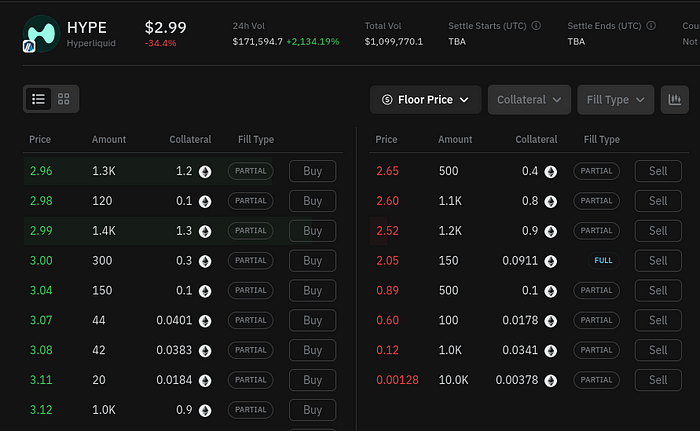
Figure 1: PRE-market HYPE Price
The Importance of Having a Strategy
Entering the market without a clear plan can be risky. Here are some general guidelines to consider:
Set Clear Goals: Determine your entry and exit points based on your risk tolerance.
Stay Informed: Keep up-to-date with official announcements from HyperLiquid.
Diversify Risks: Consider spreading out your transactions to mitigate volatility impacts.
Long-Term Perspective: Recognize that the project's value may evolve as the blockchain and additional features are fully implemented.
So!
The launch of HyperLiquid's HYPE token represents a significant event in the crypto space, offering potential opportunities for participants. By preparing adequately, understanding the key details, and approaching the launch with a well-thought-out strategy, you can navigate this event more effectively.
Remember to exercise caution, avoid impulsive decisions during periods of high volatility, and always make informed choices based on thorough research.
GetGrass is designed to enable the sharing of bandwidth via the Grass app, where users can receive Points as rewards for contributing their network resources. In the future, these Points could potentially be converted into cryptocurrency, offering users the chance to gain crypto by supporting the network. The platform's terms and conditions detail the regulations for app usage, such as age restrictions, registration necessities, and guidelines for responsible use.
You can refer as many people as you can
The Grass app aims to support open-source AI as a decentralized platform by offering a data layer and addressing data poisoning with a ZK processor and the Grass Data Ledger. Users have generally reacted positively, commending its potential and user-friendly interface. Nevertheless, there have been some criticisms regarding transparency and data security concerns raised by certain users.
Grass is a decentralized platform designed to enable users to generate passive income by sharing their unused network resources. It incorporates a ZK processor to track the origin of datasets collected on Grass, aiming to prevent data poisoning and enhance open-source AI. The Grass Data Ledger maintains a permanent record of all datasets collected, now enriched with metadata that traces their lineage from inception. Additionally, the platform includes a layer 2 solution to augment its functionality, featuring a sovereign rollup with a ZK processor that allows metadata batching for validation, thereby ensuring a continuous lineage for every dataset.
Sign up then download the Chrome extension. For optimal results, also log in across multiple devices.
Overall, GetGrass.io offers a platform that allows users to receive cryptocurrency rewards by sharing their network resources and aiding in the growth of decentralized AI.
Artificial Intelligence (AI) and blockchain are arguably two of the hottest narratives in tech today. With Berachain's mainnet launch just around the corner, combining AI with this innovative blockchain opens up exciting possibilities. In this article, we'll dive into nine AI-driven projects on Berachain, each offering unique use cases and solutions.
Baosdotfun
1. Baosdotfun: The Launchpad for AI DAOs
Baosdotfun acts as an incubator for AI-driven DAOs, focusing on areas like yield farming and trading strategies. Their "DAO seasons" introduce new AI agents every few months, providing fresh opportunities for users.
Key features:
Supports multiple AI agents.
Focus on decentralized autonomous organizations (DAOs).
Beradigm specializes in yield farming to accumulate BGT, a governance token central to Berachain's ecosystem. Using AI, Beradigm optimizes farming strategies to maximize returns.
3BC mimics traditional investment firms, with each of its three AI agents managing different portfolios. It's a blend of humor and serious blockchain strategies.
Webera leverages AI to refine yield farming strategies on Berachain. Their detailed roadmap highlights how AI integrates with blockchain to maximize farming efficiency.
Bera.tv creates personalized TV channels using AI. Users can establish their own broadcasting networks, blending content creation with blockchain technology.
HoneyFun AI simplifies the creation and launch of AI-related tokens. Their platform streamlines the token generation process and supports a growing ecosystem.
Narralayer uses AI to generate immersive stories and comics based on Berachain's lore. It's an innovative way to combine blockchain with creative storytelling.
Tierra develops DAOs tailored for specific purposes, such as fund management and yield farming. Each DAO is equipped with AI to ensure efficiency and accuracy.
The synergy between AI and blockchain is paving the way for groundbreaking projects, and Berachain is at the forefront of this innovation. From yield farming optimizations to AI-driven storytelling, these nine projects demonstrate the immense potential of combining these two narratives.
Which of these projects excites you the most? Let us know in the comments below!
The Ethereum ecosystem never stops evolving. With each new proposal, the network moves closer to a more user-friendly, efficient, and secure platform. One of the latest developments capturing attention is EIP-7702, a proposal that aims to bring native account abstraction directly to Ethereum's core protocol.
Account abstraction (AA) promises to simplify how we interact with Ethereum, enabling features like more flexible key management, batched transactions, and seamless user experiences. In this article, we'll break down what account abstraction is, how accounts currently work on Ethereum, what EIP-7702 proposes, and why it could be a game-changer for everyday users.
Understanding Ethereum Accounts Today
Ethereum currently has two primary types of accounts:
1. Externally Owned Accounts (EOA):
Controlled by a private key and public key pair.
Commonly used by individuals (you and me).
Creating an EOA costs no gas.
Has a balance of ETH/tokens, a nonce for transactions, and a unique address.
All Ethereum transactions must originate from an EOA.
2. Contract Accounts (Smart Contract Accounts):
Controlled by deployed code (smart contracts) rather than a private key.
Deploying a contract costs gas (since it stores code on-chain).
Can only send transactions in response to EOAs; they cannot independently initiate a transaction.
Have unique addresses and can be precomputed before deployment.
In simpler terms: EOAs represent users, while contract accounts represent logic defined in code. Every transaction on Ethereum begins with an EOA, limiting flexibility and user experience.
What Is Account Abstraction (AA)?
Account abstraction is the idea of transforming how user accounts function by allowing them to behave more like smart contracts. Instead of a rigid model where EOAs rely on a single private key scheme and transactions must always start there, AA introduces flexibility and programmability at the account level.
Potential benefits include:
Batch Transactions: Combine multiple actions into a single blockchain interaction, reducing complexity and cost.
Custom Logic for Wallets: Your account could implement tailored rules (e.g., daily withdrawal limits, social recovery, or advanced key schemes).
Session Keys: Useful for blockchain gaming, where multiple actions can be grouped before writing to the chain, improving the gaming experience.
Sponsor Gas Fees: Third parties could cover transaction fees for their users, enabling a smoother onboarding experience for non-crypto-savvy individuals.
Alternative Key Schemes: Introduce passkeys or different cryptographic systems beyond Ethereum's default signature method.
In short, AA can turn a basic wallet into a customizable smart contract wallet, unlocking powerful features.
Previous AA Efforts: EIP-4337 and EIP-3074
Before EIP-7702, the community had explored AA through proposals like EIP-4337 and EIP-3074:
EIP-4337: Implemented account abstraction at a layer above Ethereum's core protocol (via an alternative mempool and "bundlers"). It's powerful and currently in use, but its complexity has raised concerns about security and standardization.
EIP-3074: Another approach to delegating transaction control, but similarly complicated and not widely adopted.
While these proposals moved the ball forward, they didn't fully solve the complexity or create a unified standard. Instead, they introduced multiple paths and potential fragmentation.
Enter EIP-7702: Native Account Abstraction
EIP-7702 is a proposal by Vitalik Buterin and collaborators aiming to natively integrate account abstraction into Ethereum's core protocol. With EIP-7702:
Your EOA can become a Smart Contract Account: Instead of just using a private key–controlled EOA, you can choose to "upgrade" your account so it behaves like a contract account. This transformation is done through a new type of transaction, the SetCode transaction.
SetCode Transaction: This special transaction adds a code field to your EOA's data structure. Currently, EOAs have a balance, a nonce, and an address. With EIP-7702, we add a code field, effectively embedding smart contract logic into what was once a simple EOA.
Authorization List: The SetCode transaction includes an "authorization list" specifying parameters such as chain ID, nonce, and which contract code should govern the account. Once executed, your formerly "dumb" EOA can now act as a programmable smart contract account.
Key Advantages:
Simplicity and Security: By integrating AA directly into Ethereum, we reduce complexity and potential security risks compared to previous proposals.
Compatibility: EIP-7702 can coexist with EIP-4337 and other proposals. In fact, you can still use bundlers or paymasters from EIP-4337 to cover gas, making the new system flexible and comprehensive.
Better User Experience: DApps can offer improved UX with custom transaction handling, reduced friction, and potentially gas-subsidized interactions.
Timeline and The "Pectra" Upgrade
EIP-7702 is slated for integration into Ethereum's "Pectra" upgrade, scheduled for Q1 2025. Pectra is expected to bundle multiple EIPs, and EIP-7702's inclusion will mark a significant step towards native AA.
As a result, starting in Q1 2025 (if the upgrade proceeds as planned), your Ethereum account may no longer be limited to the current EOA model. You'll have the option to transform it into a flexible, smart-contract-based entity.
Visualizing the Transition to Smart Accounts
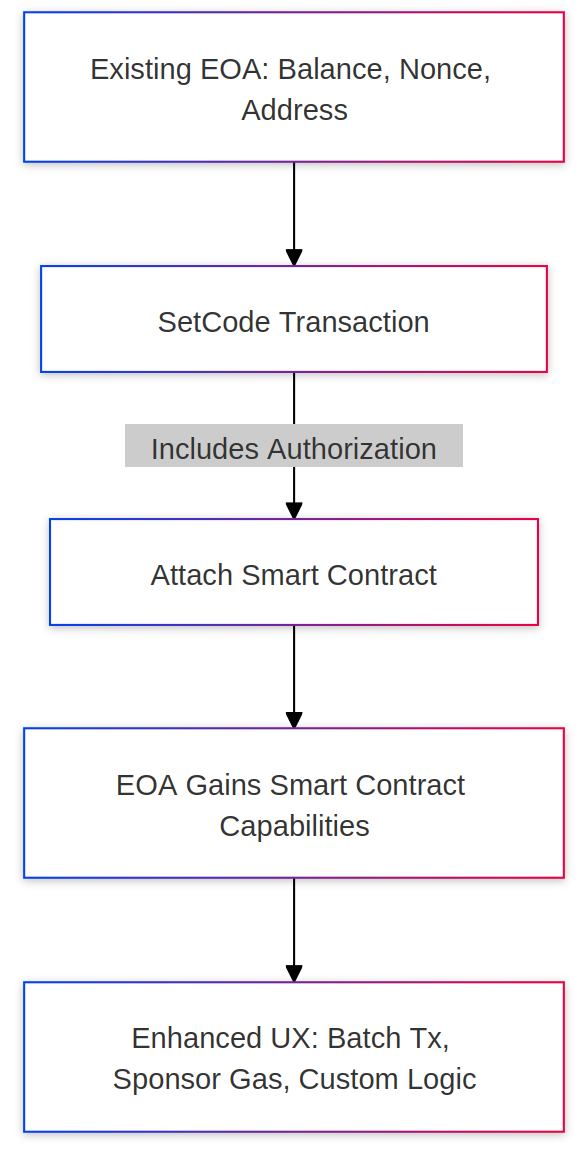
To better understand EIP-7702, let's use a Mermaid diagram. This flowchart illustrates the process of upgrading an existing EOA to a smart contract account via the SetCode transaction:
Figure 1: Visualizing the Transition to Smart Accounts
Explanation:
We start with a normal EOA.
A SetCode transaction is broadcast with authorization details.
Code is attached to the EOA's storage, transforming it into a smart contract account.
The account now can function like a contract, enabling advanced AA features.
The Road Ahead
EIP-7702 aims to standardize and streamline how we achieve account abstraction, reducing complexity and improving security. By integrating AA at the protocol level, Ethereum users can look forward to more flexible, user-friendly accounts. This approach simplifies life for developers, wallet providers, and end-users, potentially accelerating adoption and innovation in the space.
While we await Q1 2025 and the Pectra upgrade, developers and community members will continue refining EIP-7702 and other EIPs. The ultimate goal is a unified, intuitive Ethereum experience where complex key management and clunky transaction patterns become a thing of the past.
Conclusion
Ethereum's journey towards a more accessible future is well underway. With EIP-7702, the vision of native account abstraction moves from theory towards reality. This proposal can empower users with more secure, customizable, and user-friendly wallets — an essential step in bringing crypto to the next billion users.
Keep an eye on this space as Ethereum's roadmap progresses. The Pectra upgrade and EIP-7702 are just around the corner, and when they arrive, your Ethereum account might never be the same again.
Disclaimer: All timelines and proposals are subject to change based on community consensus and further technical review.
For decades, gold has been revered as a reliable store of value, offering stability in times of economic uncertainty. However, a new contender, Bitcoin, has entered the arena and is rapidly challenging gold's dominance. In this article, we will explore the dynamics between these two assets, the reasons behind Bitcoin's rise, and its potential to become the ultimate reserve currency.
Gold's Longstanding Dominance
Gold has historically been the go-to asset for hedging against inflation and maintaining wealth during economic downturns. Its physical properties — scarcity, durability, and divisibility — have made it an ideal store of value. Yet, despite its resilience against fiat currencies, gold now faces competition from Bitcoin, a purely digital asset.
Figure 1: Tradingview GOLD vs BITCOIN
Bitcoin's Meteoric Rise
Over the years, Bitcoin has showcased several attributes that position it as a potential successor to gold:
Scarcity: Bitcoin's supply is capped at 21 million coins, a hard limit enforced by its underlying code. Gold, in contrast, remains abundant in the Earth's crust and even in space, with new deposits becoming viable as its price rises.
Portability: Unlike gold, which is bulky and costly to transport, Bitcoin is weightless and can be transferred globally within minutes.
Liquidity: Bitcoin can be bought, sold, or traded instantly on digital platforms without the need for intermediaries such as brokers or banks.
Visualizing Bitcoin vs. Gold
Figure 2: Bitcoin vs. Gold
The Trump Effect and Market Trends
A pivotal moment in Bitcoin's recent history was the correlation with political developments in the U.S. During Donald Trump's presidency, pro-Bitcoin sentiments emerged, driven partly by statements from his son, Eric Trump. Eric's advocacy highlighted Bitcoin's potential to complement traditional hard assets like real estate, emphasizing its liquidity, borderless nature, and immunity to government manipulation.
Eric Trump's argument underscores Bitcoin's scarcity as a major strength. Unlike gold, whose supply can increase as prices rise, Bitcoin's fixed supply ensures its value remains undiluted. As more institutional players adopt Bitcoin, its status as a digital gold continues to solidify.
Gold vs. Bitcoin: A Comparative Analysis
Figure 3: Table Gold vs. Bitcoin: A Comparative Analysis
Theoretical Strategies: National Reserves
A growing theory suggests that nations could shift from gold reserves to Bitcoin to strengthen their financial positions. Advocates argue that selling gold to accumulate Bitcoin would:
Appreciate Bitcoin's value due to limited supply.
Dilute gold's market dominance, especially affecting countries like Russia and China, which hold significant gold reserves.
Bolster the reserves of early Bitcoin adopters like the U.S.
Flow of Wealth Simulation
Figure 3: Flow of Wealth Simulation
While this scenario is speculative, it highlights the strategic importance of Bitcoin in geopolitics.
Challenges for Bitcoin
Despite its advantages, Bitcoin faces challenges:
Volatility: Bitcoin's price remains highly volatile compared to gold.
Adoption Risks: Governments and institutions may hesitate to fully embrace a relatively new technology.
Regulatory Concerns: Stricter regulations could impact its usability and appeal.
Conclusion: A New Era of Value
Bitcoin's journey from a niche digital currency to a contender for global reserve asset is remarkable. While it's premature to declare it the outright successor to gold, its potential is undeniable. Whether as a store of value, a hedge against inflation, or a geopolitical asset, Bitcoin is reshaping our understanding of wealth and value.
As nations and institutions adapt, the dynamics between Bitcoin and gold will continue to evolve, offering new opportunities and challenges. The question remains: Will Bitcoin fulfill its promise and redefine the concept of a safe haven, or will gold retain its crown in the age of digital finance?
The Base blockchain, supported by Coinbase, is making waves in the crypto space with its surging Total Value Locked (TVL) and potential airdrop opportunities. In this article, we'll dive deep into Base's ecosystem, its key protocols, and strategies for maximizing potential rewards. We'll also explore SynFutures, a standout perpetual protocol, and other exciting opportunities that could set the stage for a lucrative airdrop.
Base Blockchain: A Rising Star
Current Status
Base has climbed to the sixth position among blockchains in terms of TVL, surpassing even Arbitrum, the long-time leader in Ethereum Layer 2 solutions. With $4 billion+ in TVL, Base's rapid growth is drawing attention from the crypto community.
Why the Excitement Around a Potential Airdrop?
Coinbase Backing: As a leading exchange, Coinbase's involvement ensures credibility and innovation.
Changing Regulations: With evolving regulatory clarity, there's renewed optimism for potential rewards like airdrops.
Donald Trump Connection: Reports of interactions between the Coinbase COO and U.S. policymakers, including Trump, suggest favorable shifts for Base and its ecosystem.
Exploring SynFutures: A Perpetual Protocol Leader
SynFutures, a decentralized perpetual protocol, has been a key player since 2021, with backing from top venture capitals like Wintermute and Polychain Capital.
Key Highlights
Cross-Chain Presence: SynFutures is active on multiple blockchains, including Base and BNB Chain.
Impressive Metrics: Handles 60–80% of perpetual derivatives volume on Base, with a cumulative trading volume exceeding $220 billion.
Airdrop Possibilities: Users staking in SynFutures can potentially earn rewards, including future airdrops.
How to Prepare for a Base Airdrop
1. Engage with Base Ecosystem Protocols:
Aerodrome: A primary DEX on Base, enabling farming and liquidity provision.
Velodrome: Offers similar features with concentrated liquidity and staking rewards.
2. Use SynFutures:
Stake assets and earn protocol-specific rewards.
Use their real-time liquidity farming feature to maximize gains.
3. Connect Wallets & Fund Accounts:
Use centralized exchanges like TapBit to transfer funds to Base.
Ensure you have enough ETH for gas fees.
Base Ecosystem Highlights
Key Protocols and Opportunities
Hidden Gems: Meme Coins on Base
The meme coin scene on Base is vibrant, with tokens like:
Bethereum: Ranked #86 in market cap, yet unlisted on Coinbase or Binance.
Toshi: A rising star with significant market activity.
Mr. Migel: High-risk but with potential upside in the meme coin niche.
Innovative Features on Base
Liquidity Farming
One standout feature is real-time liquidity farming, which lets users provide liquidity within defined price ranges for higher yields.
How It Works:
Select a price range for your liquidity pool.
Earn rewards based on the liquidity provided within the chosen range.
Adjust ranges dynamically to maximize returns.
Steps to Interact with Base
Connect Your Wallet: Use MetaMask or another compatible wallet.
Fund Your Wallet: Transfer ETH or stablecoins to Base using an exchange.
Engage with Protocols: Stake, farm, or trade on Base's leading platforms.
Conclusion: Is Base the Next Big Thing?
Base's rapid ascent and strong backing make it a compelling blockchain to watch. Whether through SynFutures, Aerodrome, or other protocols, opportunities abound for both rewards and airdrops. The key is to stay active, explore the ecosystem, and position yourself for potential gains.
Will Base redefine the Layer 2 landscape? Only time will tell, but the signs are promising. Don't miss your chance to be part of this revolutionary journey! 🚀
What do you think about the Base blockchain's potential? Drop your thoughts in the comments below!